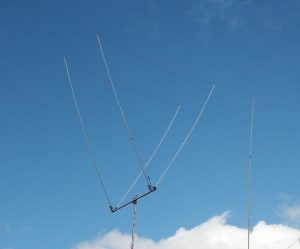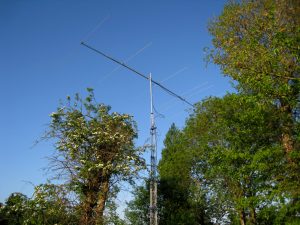
Here’s a novel design. Over the years, I’ve heard quite a few comments from 11m/Ham ops that there has never been a ‘DX’ antenna that would successfully cover 10, 11 and 12m with reasonable gain. Generally, the antenna needs to be lightweight, so we’re using 16mm and 12.7mm [1/2 inch] telescoping elements. The boom length is 7.5m so not overly long.
Ok, you could design and build your own LPA [Log Periodic Array] but with most LPAs, the gain is quite low when comparing to a monobander. Our interlaced OWA is in fact a monobander on all 3 bands. So, how does it work and what’s the magic and theory behind it all.
We start with a 3 element full size array on 12m. On it own, this would give in the region of 7.5dbi forward gain and over 20db front-to-back ratio. However, I decided to make the 12m director element function as a reflector for both 10 and 11m.
Click on any of the images below for a hi-res PDF.
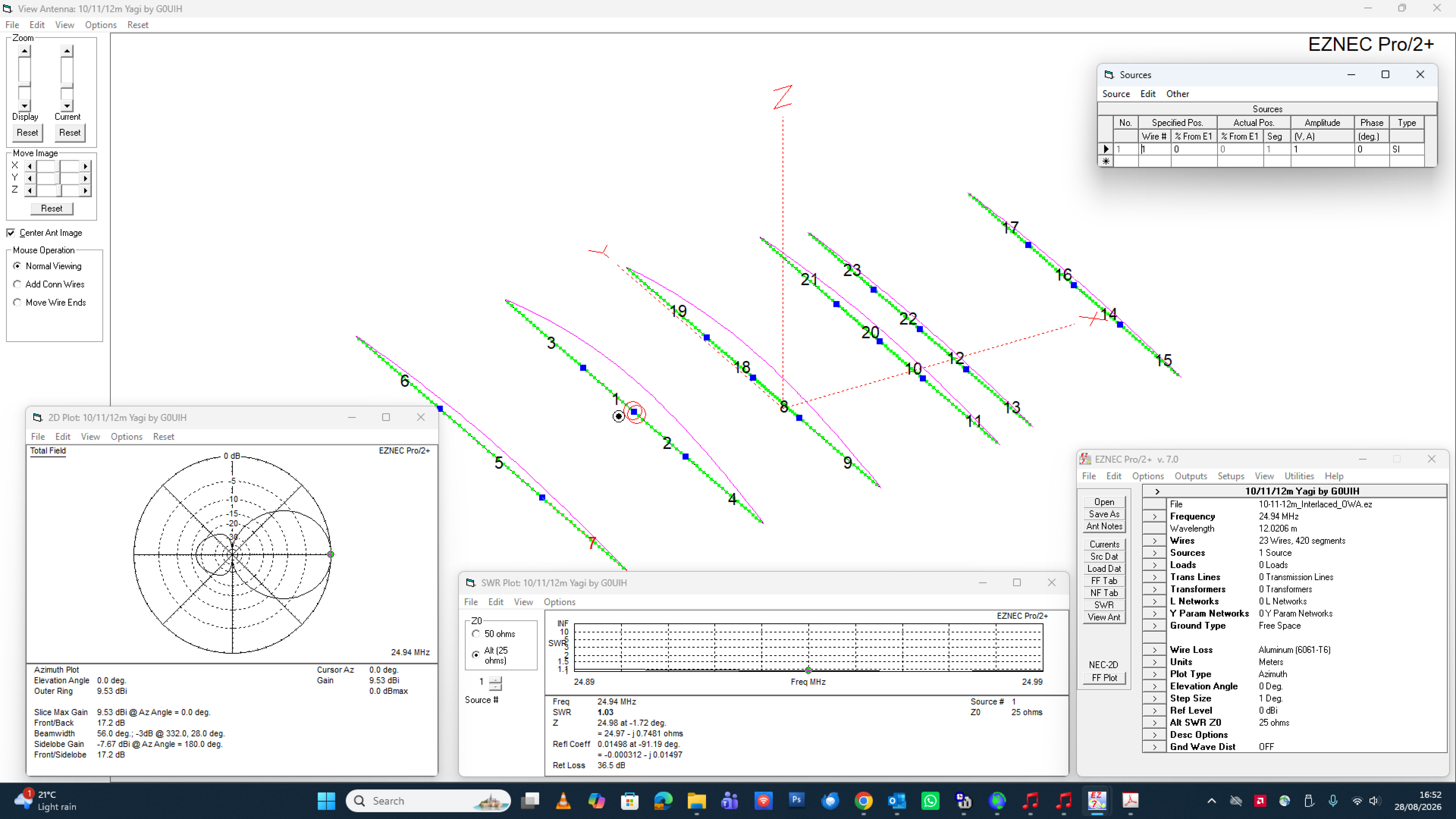
The 10 and 11m part of the array is a separate 4 element OWA [Optimised Wideband Array] in its own right and this has been interlaced with the 12m monobander.
After some careful modelling we have found that the addition of the 10/11m OWA creates a situation where a good chunk of constructive [Additional] gain is added to the 12m section. When the modelling was completed, our 3 element functioned very close to that of a 5 element monobander with a forward gain of 9.53dbi and a front to back of 17.2db.
In all case during the modelling process, front-to-back was considered the least important part of the process and overall we settled on 17db as the minimum acceptable. This still gives a good valid antenna with a reasonable pattern so on 12m, you have close to 5 element forward gain performance.
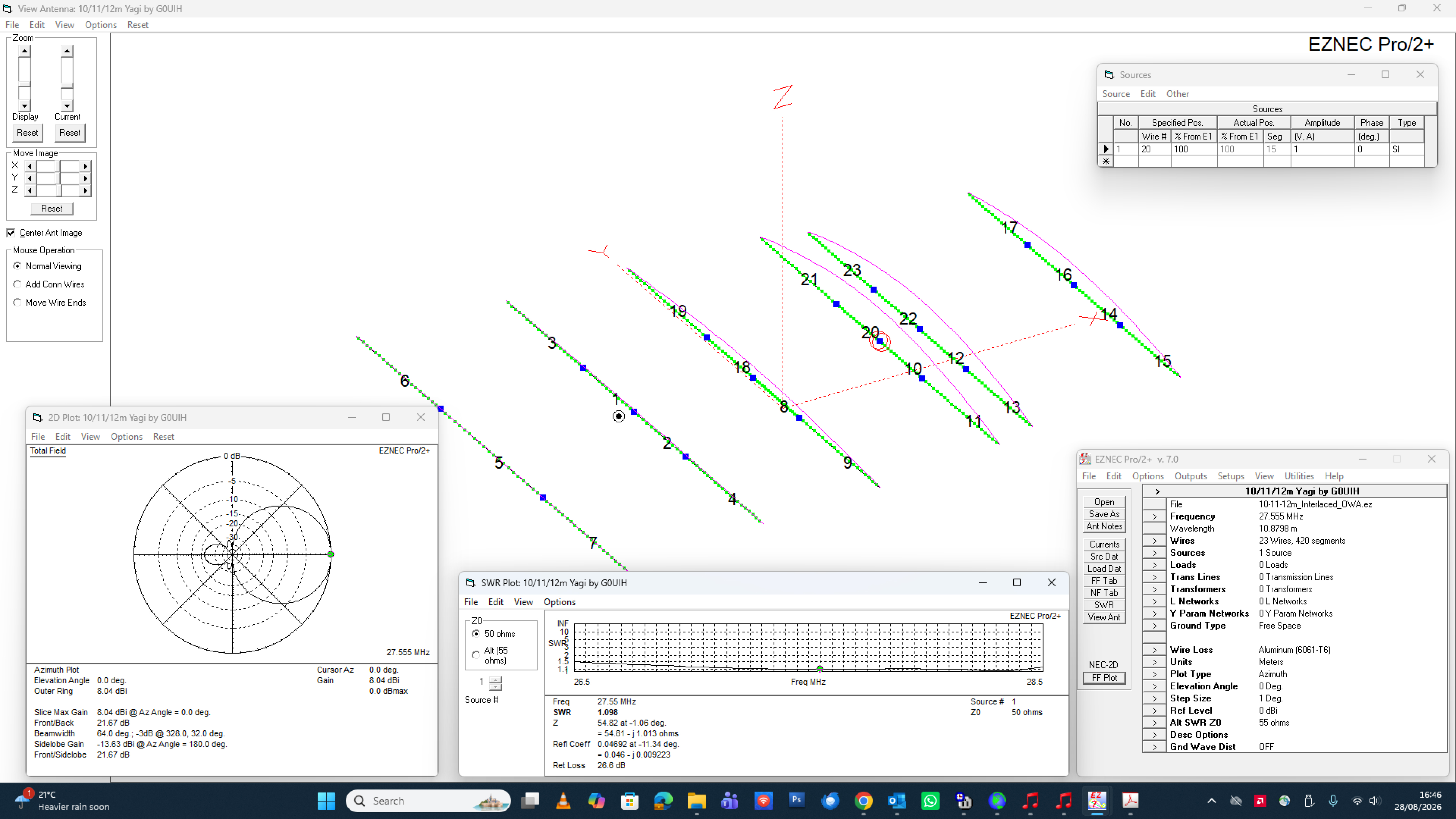
Now the 4 element OWA has been added into the mix, the 12m director also acts as a reflector for both 10 and 11m. The OWA exhibits over 8.00 dbi forward gain on 11m with a healthy 21.67db front to back. We could have increased the front to back further, but this would have dropped the gain below 8.00dbi so we settled on the above as a benchmark. At over 8dbi, this gives close to a 4 element monoband performance. Certainly better than most 3 elements.
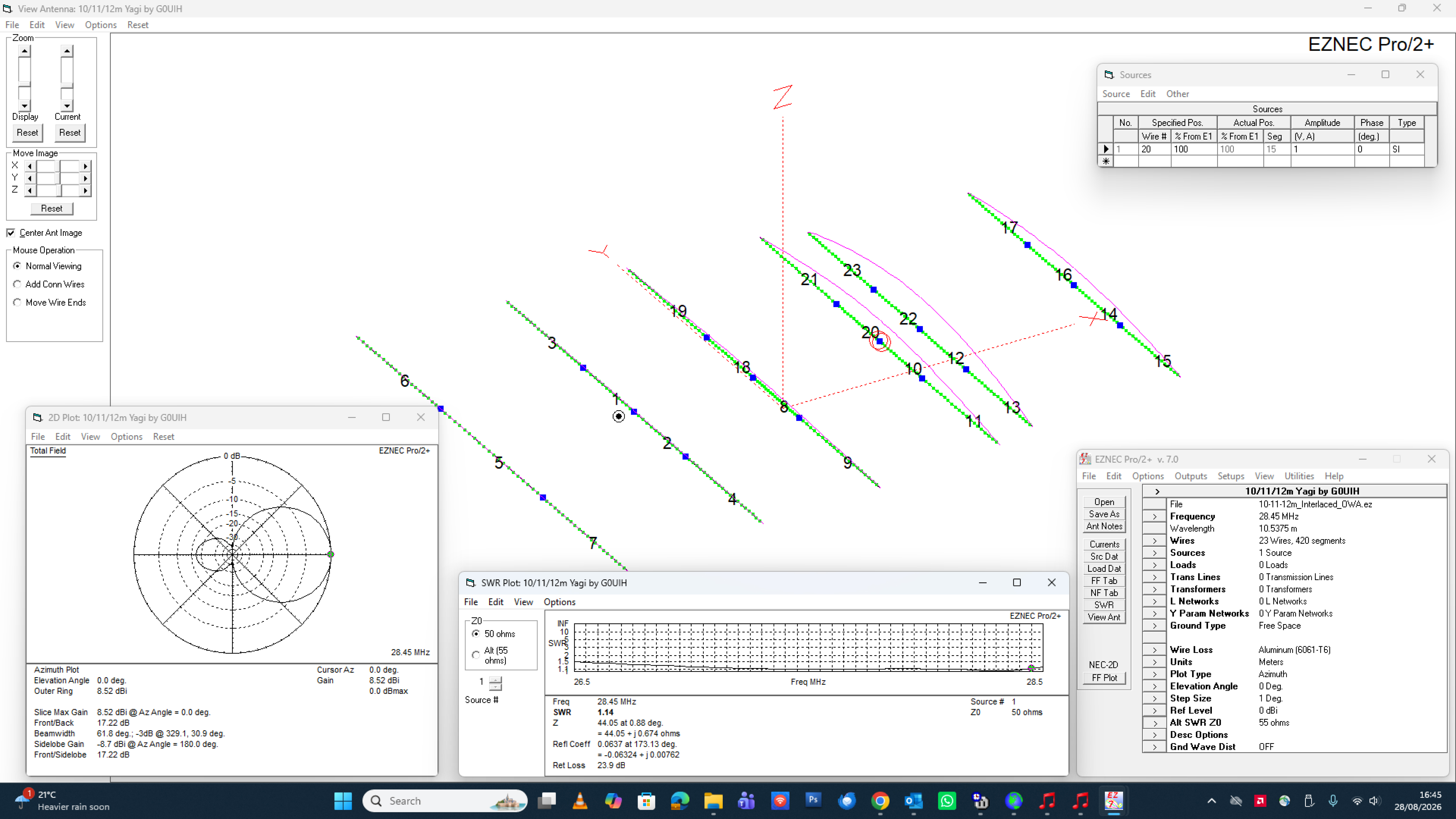
10m excels at 8.52 dbi forward gain and 17.22db front to back. Easily achieving 4 element monoband performance in forward gain and only a minor reduction in front to back. Again, we set our goals that forward gain and bandwidth were the main priorities and front to back ratio would be the least important although again we set 17db as a minimum target.
Here’s a rundown on the top points:
12m Performance:
9.53dbi forward gain, 17.20db front-to-back ratio. Performance comparable with a 5 element monobander. Covers the whole band with a flat SWR.
11m Performance:
8.04dbi forward gain, 21.67db front-to-back ratio. Performance comparable with a 3 element monobander. Covers 26.500 to 27.000 with an SWR of 1.5:1 maximum and from 27.000 to 28.000 with a flat SWR.
10m Performance:
8.52dbi forward gain, 17.22db front-to-back ratio. Performance comparable with a 4 element monobander. Covers 28.000 to 28.500 with an SWR of 1.5:1 maximum.
Feed Arrangement:
Two separate feed lines. One to the 12m driver and one to the 10/11m OWA driver.
Matching:
12m: Natural antenna impedance is approximately 25 ohms which is easily matched with a hairpin shunt.
10/11m: Natural antenna impedance is approximately 50 ohms which is to be expected in an OWA antenna. No matching is required.
Boom Length:
7.5m
Download the EZNEC file here
Can’t use EZNEC or don’t have it – download our data sheet here [coming shortly]
If you decide to build it – good luck and let me know how things went – 73 Steve G0UIH